

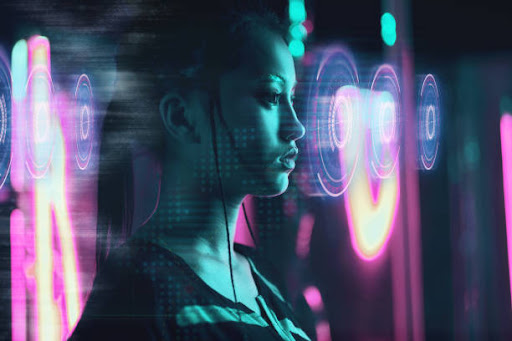
What Is a Deepfake?
A deepfake is a technology that involves creating fake content and narratives such as a fake image, audio or video of a person. The term “deepfake” is a combination of the words “deep” and “fake”. Deep means deep learning – a form of artificial intelligence (AI), while fake means unreal.
Therefore, deepfake uses deep learning AI to create falsified content for people to consume.
How Does the Deepfake Technology Work?
It is important to note that deepfakes are created using machine learning algorithms. These algorithms solve problems when a set of data is given.
The most used method of creating deepfakes involves using a neural network to study and discover the patterns necessary for replicating a convincing image. This network has an autoencoder that uses a face-swapping technique. This simply means that for the technique to work, you need a collection of video clips of the person who wants to be cloned. If the deepfake pertains to audio replication, you need a couple of audio clips of the person too. These audio and video clips do not have to relate to the target audio or video clips as the autoencoder takes care of the compilation (takes note of different posture, lighting, angles etc.)
Also, this neural network creates the machine learning algorithm needed for the deepfake. Similar to the other type of machine learning, the larger the data set, the more accurate the algorithm produced.
More accurate deepfakes make use of the Generative Adversarial Network (GAN). It contains two competing AI algorithms; the generator creates false content, and the discriminator scans it for flaws. The process is repeated until the generated content can be used as the original data. If properly modelled, the result is something the eye would not be able to differentiate.
Near-perfect deepfakes take advantage of the computing power of the cloud and a 5G bandwidth. It enables live video streams to be manipulated in real-time, making this level of deepfake lethal in the wrong hands.
Are Deepfakes Restricted to Videos?
No, deepfakes are not limited to only videos. They are used for the 3 kinds of content; visual, audio and audio-visual content. It is only more common with videos these days.
A deepfake audio takes even lesser time to create; once the audio is modelled accurately, the deepfake can say anything with the exact voice of the target person.
Applications of Deepfake
Politics: Deepfake videos have been and can be used in politics. An example of such a video is a video of Donald Trump calling on Belgium to pull out of the Paris climate agreement. A Belgian political party released this video in 2018. Trump did not give that speech; it was a deepfake. Deepfakes can be used to gain an edge over a rival political party.
Movies: If you are familiar with “Star Wars”, you might not be surprised that the deepfake technology was used in the movie. Deepfakes are employed as it saves time, effort and cost of getting some individuals.
Health care: Being able to clone a voice perfectly can prove useful in the medical industry as a voice box transplant mixed with deepfake technology can be used.
Social media: Snapchat, Tiktok and some other apps have face swap features. Some other apps on the Apple store, Google play store and Microsoft store have this feature, and it’s used solely for fun and entertainment.
Gaming: You will find this application interesting if you have a console and play adventure games. In games like Deadpool, Batman, Injustice and many more, the audio used throughout the gaming experience is not pre-recorded. The audio is a deepfake gotten through extractions from various audio clips.
How Detrimental Are Deepfakes?
Some cyber criminals have gotten a grip on using deepfakes for alternative selfish reasons. There are a lot of threats deepfake poses to individuals, companies, and society at large. Some of these threats are listed below.
- False news can lead to social unrest.
- It can lead to false electronic evidence.
- It can cause cyberbullying and blackmail.
- A deepfake can aid phishing with “convincing evidence”.
- It can lead to fraud on a small and large scale.
- Deepfakes may be used for identity theft.
- Identity theft can lead to several other crimes.
Are Deepfakes Illegal?
No, deepfake is not illegal. Infact, in most countries, there is no law regarding deepfake. The crimes that it is used to perpetuate are illegal. All the acts listed above are punishable by different laws.
In Nigeria, there is currently no law that addresses the use of deepfake in the country.
How Can You Detect a Deepfake?
Sadly, excellently modelled deepfakes cannot be differentiated from original content with the human eye. There are things to look out for, to get speculations and draw assumptions.
- Poor audio synchronisation (Lip movement different from audio sound).
- Unnatural lighting.
- Reduced pixels.
- Inconsistent blinking.
- Unrealistic hair and face colour (Although this is uncommon).
- Shaky movements.
How Technology Can Tackle Deepfake
Deepfakes will only become more realistic as time passes, so it is best to know how to tackle this technology using technology. Several companies like sensity and operation minerva are working on AIs that spot deepfakes.
Furthermore, AI softwares that can sort potential phishing videos can be created and used to separate these videos from other types of videos. It can also be used to analyse texts and spoken words.
Summary
- A deepfake is false content that looks painfully real.
- Deepfakes can be in the form of an image, audio or video.
- Deepfakes make use of machine learning algorithms.
- Near-perfect deepfakes are made using autoencoders, a Generative Adversarial Network (GAN) and a 5G bandwidth for live streams.
- Deepfakes can be used in movies, healthcare, gaming and even politics.
- Deepfakes can also be used for counter-productive things such as cyber-bullying, blackmail, identity theft and even vishing (voice phishing).
- You can detect well-modelled deepfakes with softwares. Basic deepfakes can be detected by observing unusual lighting and inconsistent skin tone.

- Machine Learning: Its Role in Cybersecurity - July 12, 2022
- The Deepfake Technology: A Rising Cybersecurity Threat - July 3, 2022
- Crypto is Cybercrime’s Currency of Choice - June 26, 2022